Demo signed off by Demo@dashboard · . The dashboard step is done on your side.
Details for YouTube
Title · 53/100
Why Is the Sky Blue? The Real Answer in Plain English
Other title options
✓ Why Is the Sky Blue? The Real Answer in Plain English 53 chars · score 13.0
The Sky Isn't Painted Blue: What Sunlight Is Really Doing 57 chars · score 12.75
Blue Skies, Red Sunsets: One Simple Idea Explains Both 54 chars · score 11.0
Description · 524/5000 bytes
Sunlight looks white, so why does the sky look blue, and why do sunsets turn red? This explainer walks through the one idea that answers both questions: how tiny air molecules scatter different colours of light.

Made for curious people with no physics background. No equations, just clear pictures and plain words.

Chapters
0:00 Intro
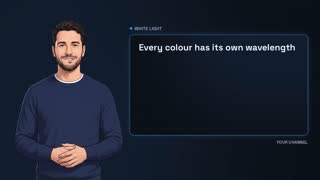
0:25 White light
1:14 Scattering
2:20 Why not violet
2:49 Sunsets
3:30 Outro

This video uses an AI narration voice, AI-generated images, an AI-generated presenter and AI-generated music.
Tags · 155/500
why is the sky blue, rayleigh scattering, why are sunsets red, science explained, physics for beginners, light and colour, atmosphere, science facts
Chapters
0:00 Intro
0:25 White light
1:14 Scattering
2:20 Why not violet
2:49 Sunsets
3:30 Outro
Made for kidsNoStart asPrivateAI useYes
(suggested — you decide)
YouTube Studio → Details → Attributes → AI use (API: status.containsSyntheticMedia)
Because:
6 photorealistic AI-generated images: YouTube asks you to disclose realistic scenes that did not happen (if every one is clearly generic, e.g. an abstract sky, you may judge otherwise)
AI-generated background music: YouTube lists AI-generated music among the examples to disclose
No disclosure needed for
script, title, description, tags and captions drafted with AI: production help, no disclosure needed
presenter 'leo' (illustration style): not photorealistic — animated or clearly unrealistic content needs no disclosure
narration by a text-to-speech voice (not a real person's voice or likeness); YouTube's page does not list this case, and the description line tells viewers
Line in the description: This video uses an AI narration voice, AI-generated images, an AI-generated presenter and AI-generated music.
Violet light scatters even more than blue, yet the sky looks blue. Here is where the violet goes.

Full video: “Why Is the Sky Blue? The Real Answer in Plain English”

This video uses an AI narration voice, AI-generated images, an AI-generated presenter and AI-generated music.

#shorts #WhyIsTheSkyBlue #WhyAreSunsetsRed #LightAndColour
Tags
why is the sky blue, why are sunsets red, light and colour, rayleigh scattering, science explained, physics for beginners, atmosphere, science facts
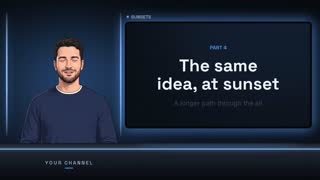
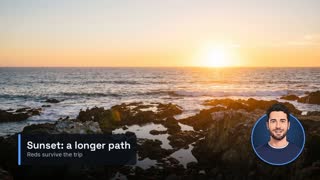
The sun doesn't change colour at sunset. Its light just takes a much longer path through the air.

Full video: “Why Is the Sky Blue? The Real Answer in Plain English”

This video uses an AI narration voice, AI-generated images, an AI-generated presenter and AI-generated music.

#shorts #WhyIsTheSkyBlue #WhyAreSunsetsRed #LightAndColour
Tags
why is the sky blue, why are sunsets red, light and colour, rayleigh scattering, science explained, physics for beginners, atmosphere, science facts
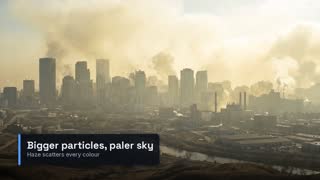
Clean air scatters mostly blue light. Haze, dust and cloud droplets scatter every colour, and all of them together look white.

Full video: “Why Is the Sky Blue? The Real Answer in Plain English”

This video uses an AI narration voice, AI-generated images, an AI-generated presenter and AI-generated music.

#shorts #WhyIsTheSkyBlue #LightAndColour #WhyAreSunsetsRed
Tags
why is the sky blue, light and colour, why are sunsets red, rayleigh scattering, science explained, physics for beginners, atmosphere, science facts
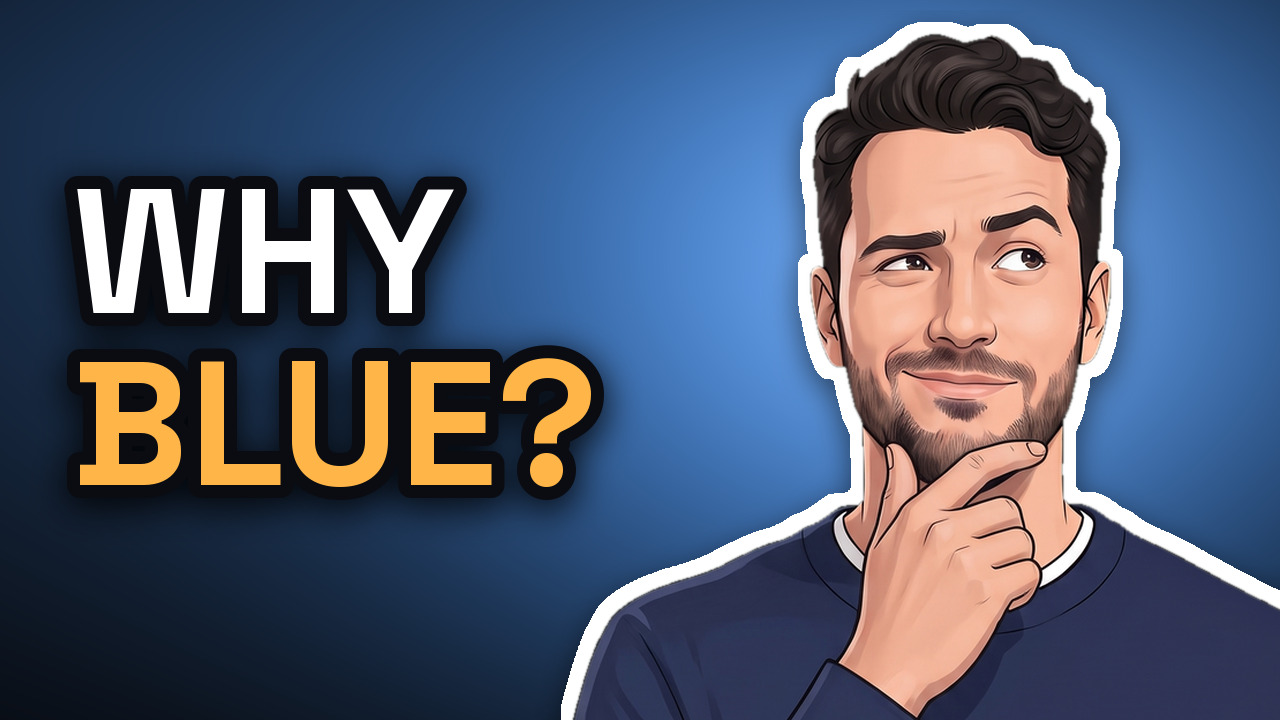
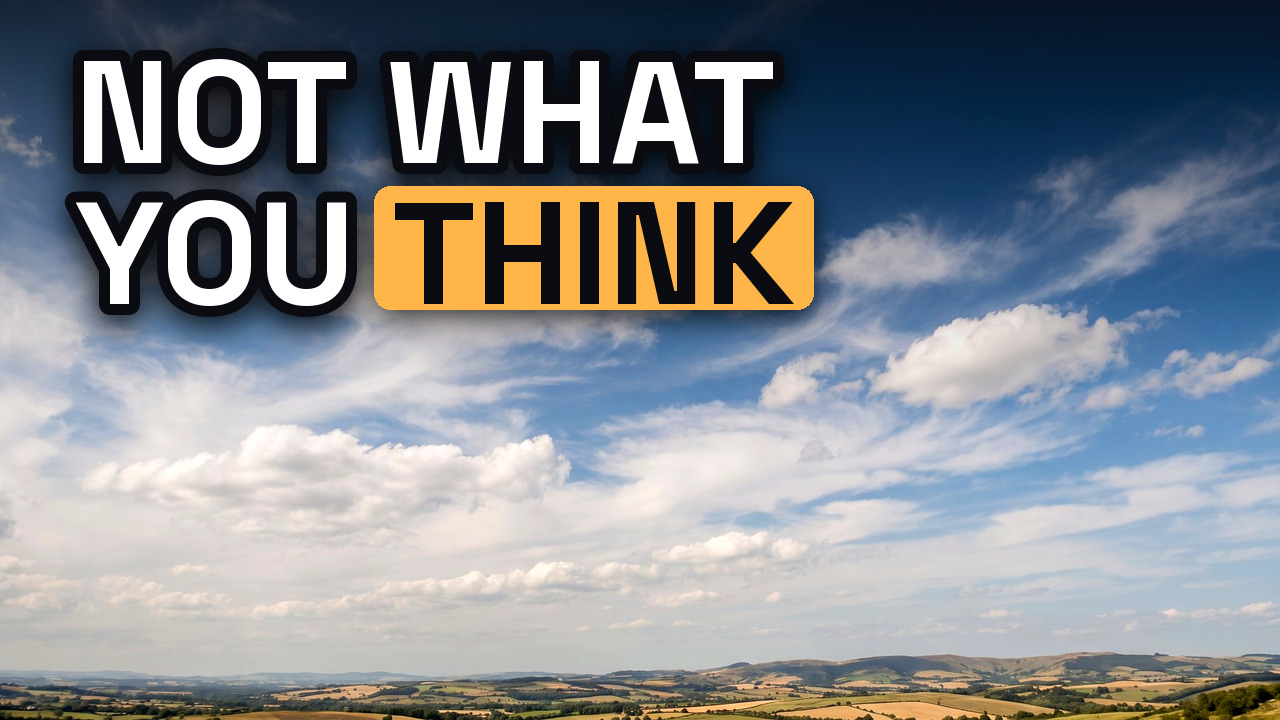
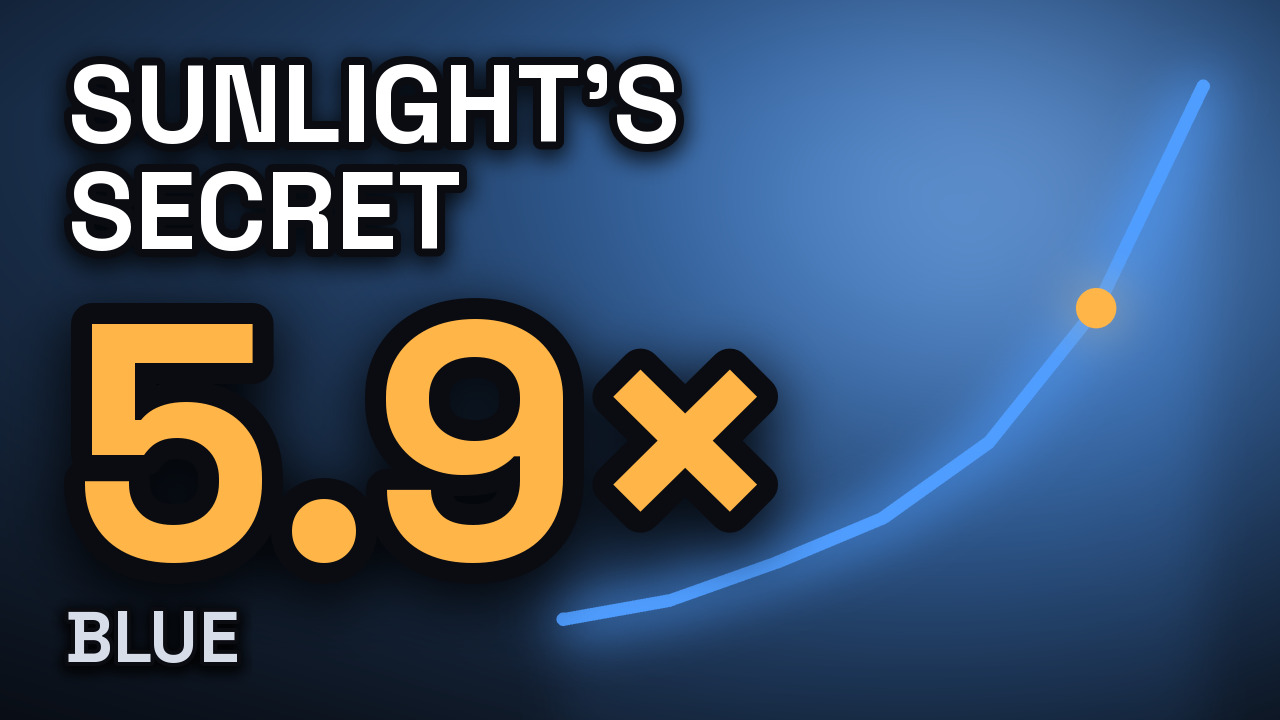
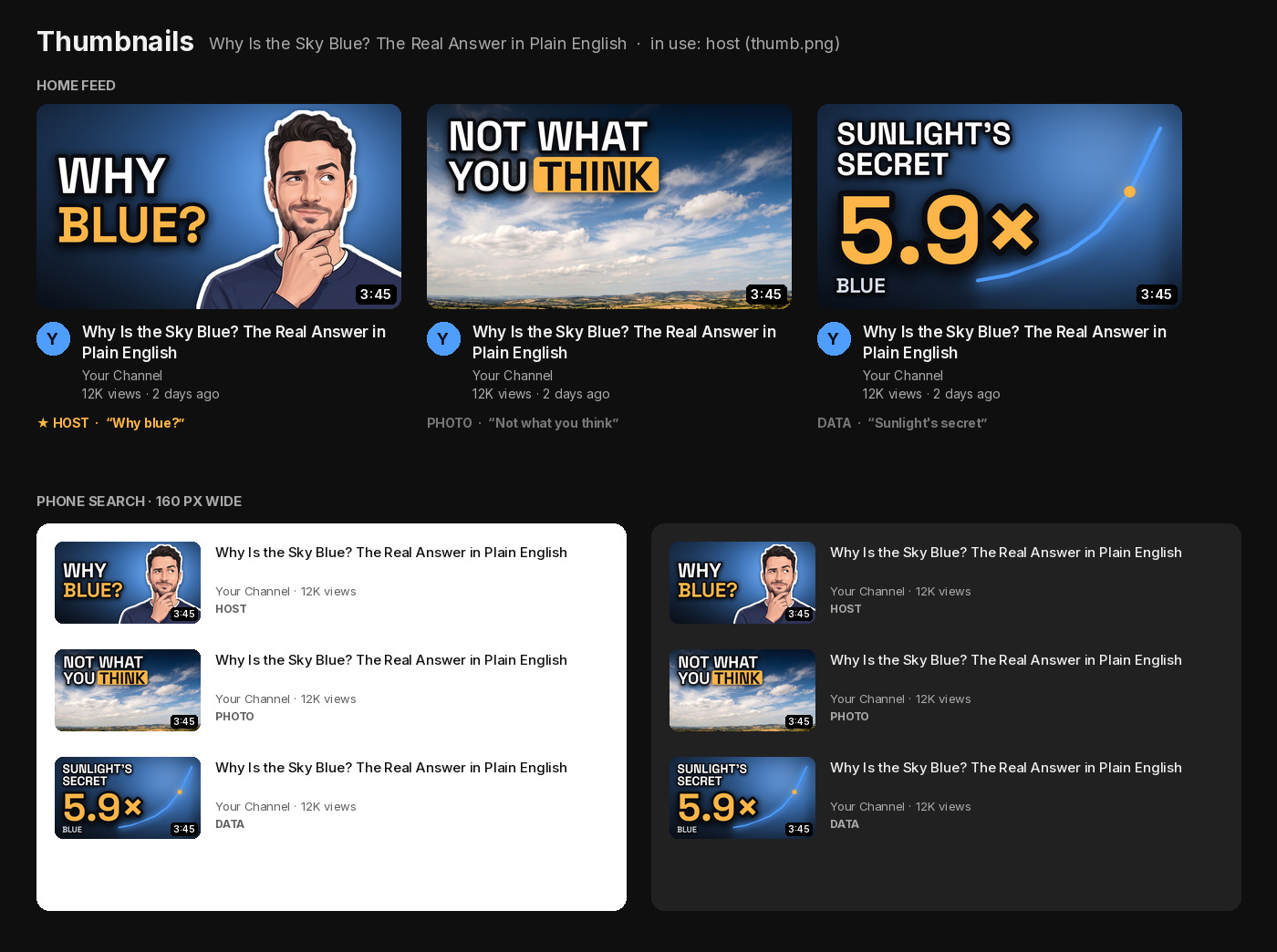
host · “Why blue?”host leo (thinking)In use (thumb.png)photo · “Not what you think”b-roll s007data · “Sunlight's secret”figure 5.9× (line_chart)
How they look in the feed and in phone search
Music
Enginea music file that ships with the studio (AI-generated)Moodcalm
Listen to the bed (first 30 s):
AI-generated from a text prompt (no recording or sample was supplied as input); carries an invisible AI watermark. Bundled with this kit as the demo's music.
Quality check
the demo's sample video gets no paid AI review (the paid AI review is off) · Loudness -14.6 LUFS · true peak -1.8 dB
no material issue (local checks only: no AI review ran)
at
severity
what
fix
long
minor
s009: the card is 38% built 1.5 s in — it opens on an empty panel
Fix: start the build earlier (the first element should land in about a second)
Captions
106 cues · tap a time to jump there
Look up on a clear day
and the sky is blue.
But sunlight itself looks white,
and space is black.
So where does all that blue come
from, and why does the same sky turn orange
and red at sunset?
The short version fits in one sentence:
air scatters blue light far
more than red light.
The rest of this video unpacks
what that means, why it happens,
and how the same idea explains sunsets.
First, sunlight is not one colour.
It is a mix of every colour
of the rainbow, travelling together.
When they arrive at your eye
in roughly equal amounts,
your brain reads the mix as white.
Each colour is light
with a different wavelength, the distance
from one wave crest to the next.
Red waves are about 700 nanometres long,
a nanometre being a millionth of a millimetre.
Green is about 530, blue about 450, and violet,
the shortest we can see, about 400.
A prism proves the mix is there.
It bends short waves
a little more than long ones,
so white light fans out into a rainbow,
traditionally named as 7 colours.
So if sunlight holds every colour,
what happens to it on the way down?
Before sunlight reaches you, it passes
through miles of air.
Air is mostly nitrogen
and oxygen molecules, far smaller
than a wavelength of light.
When light hits them, some
of it bounces off in new directions.
That is called scattering.
Here is the key.
For particles much smaller than the wavelength,
the amount of scattering rises very steeply
as the wavelength gets shorter.
Physicists call it Rayleigh scattering,
after the scientist
who worked it out in the 1800s.
How steep?
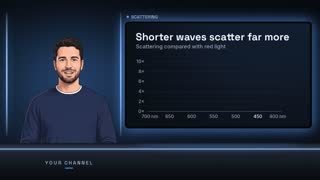
Blue light is scattered about 5.9 times
more strongly than red, and violet,
the shortest wave, about 9.4 times.
So as sunlight crosses the sky, blue
is constantly knocked sideways,
while red mostly carries straight on.
Now picture any patch
of sky away from the sun.
The light reaching you from there is light
that was scattered toward your eye.
And scattered light is mostly blue.
That is why the whole dome
of the sky glows blue.
But if violet scatters even
more, why isn't the sky violet?
Violet does scatter even more than blue.
Three things work against it.
Sunlight contains less violet
to begin with.
Some of it is absorbed high
in the atmosphere.
And your eyes are simply much
less sensitive to violet than to blue.
Your eyes read colour
with three kinds of cone cells.
The scattered skylight excites the blue ones
and a little of the green ones,
and your brain adds that up
as a pale sky blue rather
than a deep violet.
The same idea explains sunsets.
When the sun is low,
its light travels through much more air
to reach you than at noon.
Along that long path,
most of the blue gets scattered away
before it arrives.
What survives the trip is the light
that scatters least: oranges and reds.
So the sun and the clouds near
it glow warm, while the blue
that was scattered out is lighting up
the sky for people farther west.
Dust, smoke
and larger droplets change the picture.
Bigger particles scatter all colours
more evenly, which is why haze looks white
or grey, and why smoke from distant fires
can make sunsets especially deep red.
So the sky is blue
because air scatters short blue waves far
more than long red ones,
and sunsets are red because a long path
through the air strips the blue away.
Got a question,
or spotted something to correct?
Tell us in the comments.
Script
Intro 2 segments
s001 · title · presenter
Look up on a clear day and the sky is blue. But sunlight itself looks white, and space is black. So where does all that blue come from, and why does the same sky turn orange and red at sunset?
s002 · photo · inset
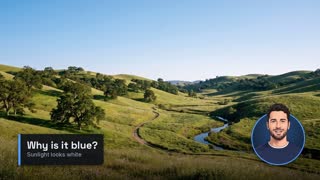
The short version fits in one sentence: air scatters blue light far more than red light. The rest of this video unpacks what that means, why it happens, and how the same idea explains sunsets.
White light 3 segments
s003 · section · set
First, sunlight is not one colour. It is a mix of every colour of the rainbow, travelling together. When they arrive at your eye in roughly equal amounts, your brain reads the mix as white.
s004 · table · presenter
Each colour is light with a different wavelength, the distance from one wave crest to the next. Red waves are about 700 nanometres long, a nanometre being a millionth of a millimetre. Green is about 530, blue about 450, and violet, the shortest we can see, about 400.
s005 · photo · full
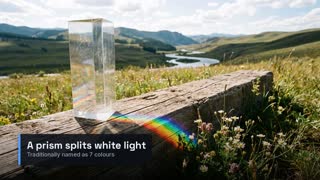
A prism proves the mix is there. It bends short waves a little more than long ones, so white light fans out into a rainbow, traditionally named as 7 colours. So if sunlight holds every colour, what happens to it on the way down?
Scattering 4 segments
s006 · section · set
Before sunlight reaches you, it passes through miles of air. Air is mostly nitrogen and oxygen molecules, far smaller than a wavelength of light. When light hits them, some of it bounces off in new directions. That is called scattering.
s007 · clip · inset
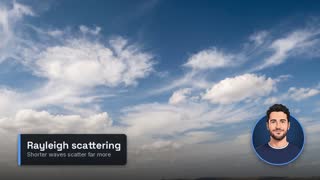
Here is the key. For particles much smaller than the wavelength, the amount of scattering rises very steeply as the wavelength gets shorter. Physicists call it Rayleigh scattering, after the scientist who worked it out in the 1800s.
s008 · line_chart · set
How steep? Blue light is scattered about 5.9 times more strongly than red, and violet, the shortest wave, about 9.4 times. So as sunlight crosses the sky, blue is constantly knocked sideways, while red mostly carries straight on.
s009 · steps · inset
Now picture any patch of sky away from the sun. The light reaching you from there is light that was scattered toward your eye. And scattered light is mostly blue. That is why the whole dome of the sky glows blue. But if violet scatters even more, why isn't the sky violet?
Why not violet 2 segments
s010 · section · presenter
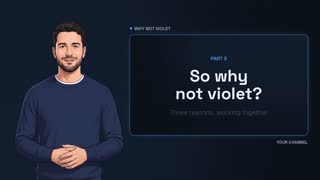
Violet does scatter even more than blue. Three things work against it. Sunlight contains less violet to begin with. Some of it is absorbed high in the atmosphere. And your eyes are simply much less sensitive to violet than to blue.
s011 · photo · full
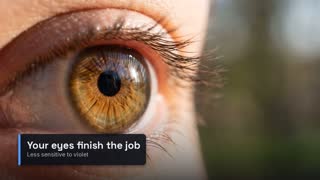
Your eyes read colour with three kinds of cone cells. The scattered skylight excites the blue ones and a little of the green ones, and your brain adds that up as a pale sky blue rather than a deep violet.
Sunsets 3 segments
s012 · section · set
The same idea explains sunsets. When the sun is low, its light travels through much more air to reach you than at noon. Along that long path, most of the blue gets scattered away before it arrives.
s013 · photo · inset
What survives the trip is the light that scatters least: oranges and reds. So the sun and the clouds near it glow warm, while the blue that was scattered out is lighting up the sky for people farther west.
s014 · photo · full
Dust, smoke and larger droplets change the picture. Bigger particles scatter all colours more evenly, which is why haze looks white or grey, and why smoke from distant fires can make sunsets especially deep red.
Outro 1 segments
s015 · outro · set
So the sky is blue because air scatters short blue waves far more than long red ones, and sunsets are red because a long path through the air strips the blue away. Got a question, or spotted something to correct? Tell us in the comments.
Pipeline log
last 40 lines
01:42:25 render: s001 done (1/15)
01:42:50 render: s002 done (2/15)
01:43:04 render: s003 done (3/15)
01:43:31 render: s004 done (4/15)
01:44:00 render: s005 done (5/15)
01:44:16 render: s006 done (6/15)
01:44:45 render: s007 done (7/15)
01:45:06 render: s008 done (8/15)
01:45:25 render: s009 done (9/15)
01:45:45 render: s010 done (10/15)
01:46:14 render: s011 done (11/15)
01:46:29 render: s012 done (12/15)
01:46:59 render: s013 done (13/15)
01:47:22 render: s014 done (14/15)
01:47:38 render: s015 done (15/15)
01:47:38 render done in 328s
01:47:38 assemble …
01:48:06 assemble done in 28s
01:48:06 captions …
01:48:06 captions done in 0s
01:48:06 shorts_media …
01:48:06 shorts_media done in 0s
01:48:06 shorts …
01:48:06 voice: the free voice (Michael) is voicing new takes …
01:48:26 voice: the free voice (Michael) is voicing new takes …
01:48:41 voice: the free voice (Michael) is voicing new takes …
01:48:58 shorts: 3 of 3 Shorts to render, 3 to mix
01:49:55 render: short_1 done (1/3)
01:50:42 render: short_2 done (2/3)
01:51:29 render: short_3 done (3/3)
01:51:41 shorts done in 216s
01:51:42 meta …
01:51:44 thumbs: host “Why blue?” (149 KB), photo “Not what you think” (199 KB), data “Sunlight's secret” (122 KB) — thumb.png = host; see thumbs/preview.jpg
01:51:44 meta: AI use at upload — suggested answer Yes (6 photorealistic AI-generated images; AI-generated background music)
01:51:44 meta done in 2s
01:51:44 qa …
01:52:55 qa: local checks only (the demo's sample video gets no paid AI review (the paid AI review is off)) · 0 material, 1 minor · verdict pass: no material issue (local checks only: no AI review ran)
01:52:55 qa done in 71s
01:52:55 review …
01:52:55 review done in 0s
Edited the script with Claude? This re-renders just the parts that changed.